DeepSeek and Nvidia
Less is Moore
A cheap Chinese model has rattled the AI trade, but it makes computing cheaper rather than pointless, and the bill for the boom will still be paid
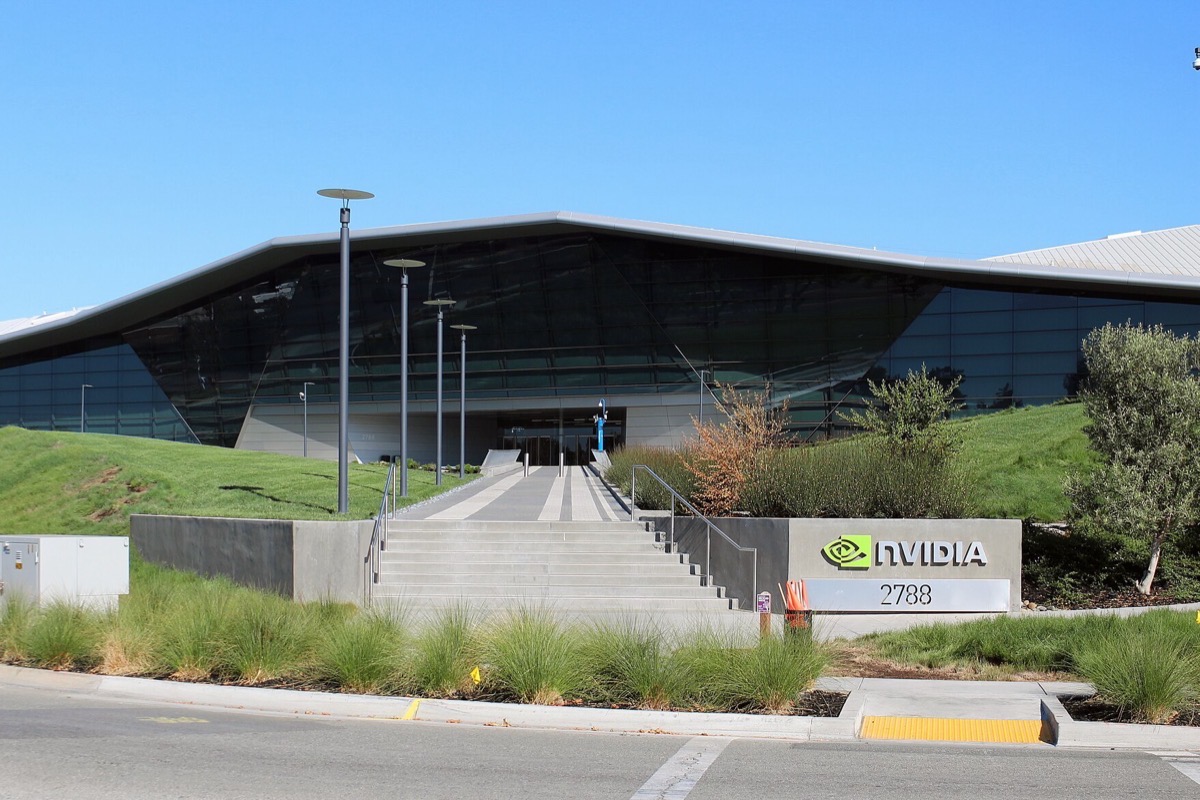

Some $589bn. That is how much stockmarket value Nvidia lost on 27 January, when its shares fell by 17%. No company in American history has shed more in a single day; the previous record, about $279bn, was Nvidia’s own, set in September.1BloombergNvidia's $589 billion DeepSeek rout is largest in market history27 Jan 2025 The cause was not a profit warning or a lawsuit but a research paper and a free app from DeepSeek, a Chinese lab, whose chatbot had just overtaken ChatGPT at the top of Apple’s American download chart.7TechNodeDeepSeek AI assistant surpasses ChatGPT on US App Store27 Jan 2025
The number that spooked investors was smaller. In its technical report on V3, the model underneath the app, DeepSeek says the final training run took 2.788m hours of time on Nvidia’s H800 chips, a version deliberately hobbled to comply with American export rules. At an assumed rental price of $2 an hour that comes to $5.6m.2arXivDeepSeek-V3 technical report27 Dec 2024 If a frontier-grade system can be built for the price of a Bay Area house or two, the logic went, perhaps the world does not need quite so many of Nvidia’s chips.
Before the fall
Nvidia data-centre revenue by fiscal quarter, $bn
| Data centre | |
|---|---|
| Q1 FY24 | 4.3 |
| Q2 FY24 | 10.3 |
| Q3 FY24 | 14.5 |
| Q4 FY24 | 18.4 |
| Q1 FY25 | 22.6 |
| Q2 FY25 | 26.3 |
| Q3 FY25 | 30.8 |
That logic collides with what the buyers said only days ago. On 21 January OpenAI, SoftBank and Oracle unveiled Stargate, a venture that plans to put $500bn into American AI infrastructure over four years, starting with $100bn “immediately”.3OpenAIAnnouncing the Stargate Project21 Jan 2025 Microsoft has said it will spend some $80bn on AI-capable data centres in the year to June.4BloombergMicrosoft to spend $80 billion on AI data centers this year3 Jan 2025 On 24 January Mark Zuckerberg said Meta would lay out $60bn-65bn in capital spending in 2025 and end the year with more than 1.3m graphics processors.5QuartzMark Zuckerberg is ready to drop up to $65 billion on AI this year24 Jan 2025 That money has driven Nvidia’s data-centre business from quarterly revenue of $4.3bn to $30.8bn in a year and a half8NvidiaNVIDIA announces financial results for first quarter fiscal 202424 May 2023,9NvidiaNVIDIA announces financial results for second quarter fiscal 202423 Aug 2023,10NvidiaNVIDIA announces financial results for third quarter fiscal 202421 Nov 2023,11NvidiaNVIDIA announces financial results for fourth quarter and fiscal 202421 Feb 2024,12NvidiaNVIDIA announces financial results for first quarter fiscal 202522 May 2024,13NvidiaNVIDIA announces financial results for third quarter fiscal 202520 Nov 2024 (by the summer it was already $26.3bn).6NvidiaNVIDIA announces financial results for second quarter fiscal 202528 Aug 2024
The bears’ case deserves a hearing, and it is better than “China wins”. Nvidia’s valuation assumed that the hunger for computing would keep rising roughly in step with the size of models, and that the firm could keep charging scarcity prices while it lasted. DeepSeek’s paper is a long list of engineering economies: a “mixture of experts” design that wakes only a fraction of the network for each query, lower-precision arithmetic, and careful work to keep 2,048 chips busy.2arXivDeepSeek-V3 technical report27 Dec 2024 If such tricks spread, and DeepSeek has published its weights for anyone to copy, the cost of a given level of intelligence falls fast. Customers who bought chips at a premium to secure scarce capacity may decide that scarcity is over. A firm priced for permanent shortage is exposed to any hint of plenty.
We think the market has nonetheless drawn the wrong conclusion. First, the $5.6m is not what DeepSeek spent. The report itself says the figure covers “only the official training” of V3 and excludes “prior research and ablation experiments”, the many failed and partial runs that precede a good one, not to mention the cost of owning the 2,048 chips in the first place.2arXivDeepSeek-V3 technical report27 Dec 2024 Second, cheaper computing has rarely meant less of it. When the cost of a useful thing falls, people find more uses for it; economists call this the Jevons paradox, after a Victorian who noticed that more efficient steam engines raised Britain’s coal consumption. Models that cost less to train and run will be put into more products, and those products will run on someone’s chips. Third, the money already committed does not vanish because a share price did. Stargate, Microsoft and Meta set their budgets for strategic reasons, and all three were announced within the past four weeks.
What DeepSeek has punctured is not the AI boom but the comfortable idea that America’s labs had a moat made of capital. Export controls have kept the best chips out of China, and a Chinese team has responded by doing more with worse ones. That is bad news for any American lab charging premium prices for a model that a rival can approximate cheaply, and good news for everyone who buys AI rather than sells it. Pricing power, not demand for chips, is the thing now in doubt.
Nvidia will probably sell every chip it can make this year. It may simply have to accept that being the only shovel-seller in a gold rush is different from being the only one who knows where the gold is.
This article appeared in the Business & Finance section of Issue No. 2, 4 October to 10 October 2026
Sources
- Nvidia's $589 billion DeepSeek rout is largest in market history Bloomberg, 2025-01-27 a
- DeepSeek-V3 technical report arXiv, 2024-12-27 abc
- Announcing the Stargate Project OpenAI, 2025-01-21 a
- Microsoft to spend $80 billion on AI data centers this year Bloomberg, 2025-01-03 a
- Mark Zuckerberg is ready to drop up to $65 billion on AI this year Quartz, 2025-01-24 a
- NVIDIA announces financial results for second quarter fiscal 2025 Nvidia, 2024-08-28 a
- DeepSeek AI assistant surpasses ChatGPT on US App Store TechNode, 2025-01-27 a
- NVIDIA announces financial results for first quarter fiscal 2024 Nvidia, 2023-05-24 a
- NVIDIA announces financial results for second quarter fiscal 2024 Nvidia, 2023-08-23 a
- NVIDIA announces financial results for third quarter fiscal 2024 Nvidia, 2023-11-21 a
- NVIDIA announces financial results for fourth quarter and fiscal 2024 Nvidia, 2024-02-21 a
- NVIDIA announces financial results for first quarter fiscal 2025 Nvidia, 2024-05-22 a
- NVIDIA announces financial results for third quarter fiscal 2025 Nvidia, 2024-11-20 a